Mastering the Thin Air: LIV Golf players must adjust to Chapultepec’s high altitude
Apr 15, 2026 - 6:30 PMWritten by: Matt Vincenzi

MEXICO CITY – As the LIV Golf field arrives in Mexico City for the league’s latest stop at Club de Golf Chapultepec, there is work to be done outside of practicing on the range and reading greens. This week, the field will need to work hard to rewrite the numbers in their yardage books.
At 7,864 feet above sea level, Chapultepec will play as the highest elevation venue on the LIV Golf schedule. The thin air dramatically reduces drag on the golf ball, causing shots to fly noticeably farther than they do at sea level. Every player and caddie must make careful, detailed adjustments to how they approach the 7,443-yard par-71 layout.
Some adjustments for the altitude ⛰️
— LIV Golf (@livgolf_league) April 14, 2026
A look at Billy Foster’s inner workings in Mexico 👀#LIVGolfMexicoCity | @MajesticksGC pic.twitter.com/34q9J7obni
The adjustment process begins immediately upon arrival. With launch monitors set up on the practice range, teams are busy mapping out yardages tailored to each player’s ball flight. Most estimates suggest the ball carries anywhere from 10-18% farther here in Mexico City. High-launch players often see a bigger overall boost, while those who prefer lower, more penetrating shots gain a bit less. 4Aces GC star Anthony Kim and his caddie Grant Bennett have decided on a calculation of 13-17% per shot “depending on distance and trajectory,” Bennett explained.
Legion XIII star Tom McKibbin gave insight into how he gets his yardages dialed in.
“Just on the range, turn the TrackMan on, the elevation, get the yardages from that,” McKibbin said.
He added that he normally starts with a meters book this week because it feels a little closer to normal, then applies roughly five more percent adjustment.
“A lot of work on the range … making sure it’s going what we think," McKibbin said. "Sort of have a rough guess before we get here and then sort of confirm once everything goes down."
He confirmed this is the highest elevation he can ever remember playing. With the altitude adding roughly 12% or more to carry on driver, not including the additional roll out on Chapultepec’s firm fairways, solid drives are turning into massive ones.
McKibbin’s teammate Caleb Surratt hit a stunning 487.5-yard drive on the 11th hole in Round 2 last year, the longest drive in LIV Golf history to date. Surratt, who has always felt comfortable at altitude, said players need to be really dialed in with their numbers.
“I try to kind of figure out how to dial it down or dial it up or however you want to do it with the yardage,” he explained.
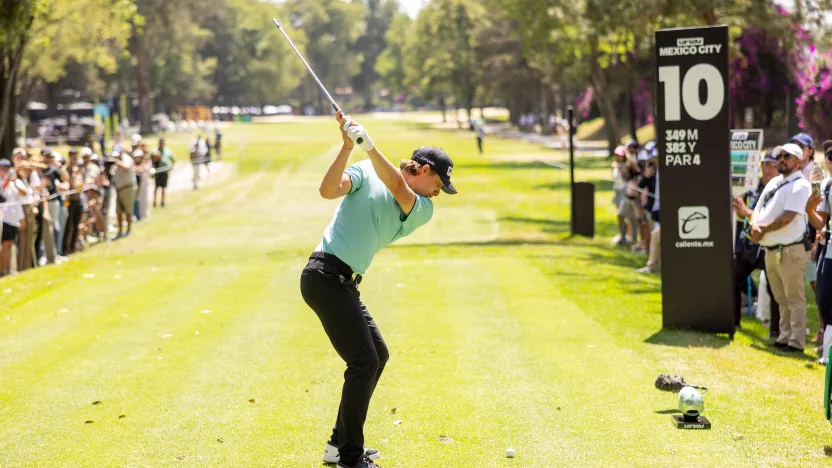
Surratt noted that the flight of the shot can dramatically change the effective yardage.
“Another thing people don't really talk about sometimes is how the flight of the number or the flight of the shot is going to change the yardage so much," Surratt said. "So, if it's a back pin and I want to flight my wedge, it's not going to get like the normal 15% or 20%. It's going to get like 5% to 8%. But if it's a front pin and downhill and I'm trying to send it up in the air, it might be getting 25% because the ball's in the air for so long.
"Just these little nuances that you got to think about and factor into your shot. But it's certainly tricky.”
Surratt added that golfers have to accept some imperfections.
“I think you've got to realize you're not going to be perfect, right?," Surratt said. "You're going to hit some shots that are perfect and then come up short or go long. I think the thing is everybody's kind of going to have a little bit of that. So, yeah, it's just get an adjustment game and trust your shots.”
McKibbin admitted it’s cool hitting 400-yard drives because of the altitude but quickly pointed out the downside.
“The trees come into play a lot easier when you hit it that far," he said. "So, yeah the driving’s cool, but the second shots are definitely very hard. Much harder.”
He explained that approaches are especially tricky depending on the lie.
“Especially if you’re hitting uphill and the ball doesn’t get as high, it might not carry as far, and downhill and downwind it can really get away from you, so I think it’s very tricky,” McKibbin said.
The ball also lands with less spin in the thinner air, so shots that normally check up can release more aggressively on approach shots. Therefore, not only do players have to rethink their yardages, they also have to rethink their landing spots.
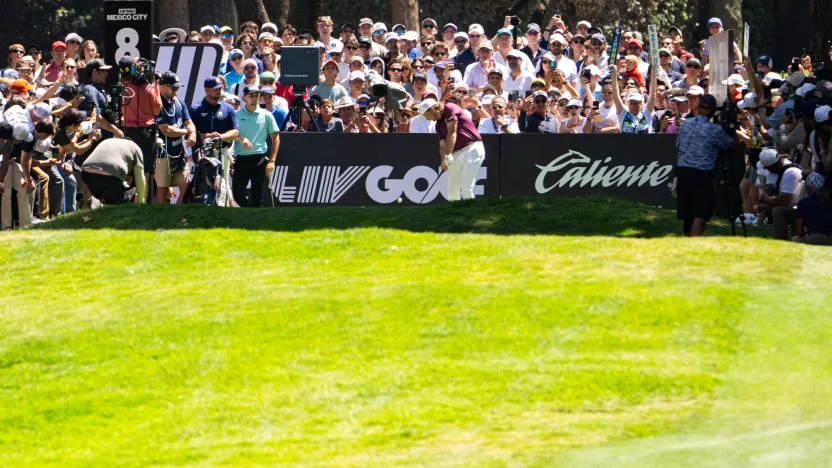
Fireballs GC captain Sergio Garcia echoed the challenge of second shots in the thin air, stressing that trajectory plays a critical role in how much extra distance the ball actually carries. He explained that players must account for their normal ball flight when making altitude adjustments.
“The biggest percentage that you’d see in distance for a player like me that doesn’t hit it as high with the driver. It would be from the wedge to the 5-iron,” Garcia explained. “The higher you hit it, the longer the ball stays in the air. So if you bring it down with a 6-iron, the altitude is not going to affect it as much. You have to make sure that you calibrate all of these things to get the best guess on how far the ball is going to go.”
The added distance off the tee is best illustrated by Bryson DeChambeau’s driving stats from last year at Chapultepec, where he recorded five drives of 400 yards or longer along with several more in the 350-399 yard range.
Fireballs GC star Josele Ballester, who joined LIV Golf after the 2025 Mexico City event and made his professional debut mid-season last year, has quickly established himself as one of the longest hitters in the league. He currently leads LIV Golf in driving distance this season and has already shown a flair for massive carries in the thin air. Ballester has been vocal about embracing the altitude advantage, famously noting that because DeChambeau had five drives of 400 yards or longer here last year, he plans to top that mark.
“Six, at least six,” Ballester said with a smile. “I've been speed training a little bit for this occasion in Arizona last week, and it's pretty fun to just tee it up high and send it when the ball goes this far. But the course is pretty tight, so you know, you got to have the accuracy as well to hit those shots. So, you never know."
At Chapultepec, distance is easy to find, but precision is not. In air this thin, the difference between a perfect shot and a costly mistake can be just a few yards of miscalculation. Bombing 400-yard drives may grab attention, but this week will be decided by the players who can control their numbers when it matters most.